Sudowrite Alternatives for Writers Who Need Story Memory
Looking for a Sudowrite alternative? The best AI writing tools for novelists compared on story memory, control, uncensored fiction, pricing and export, plus a free option.
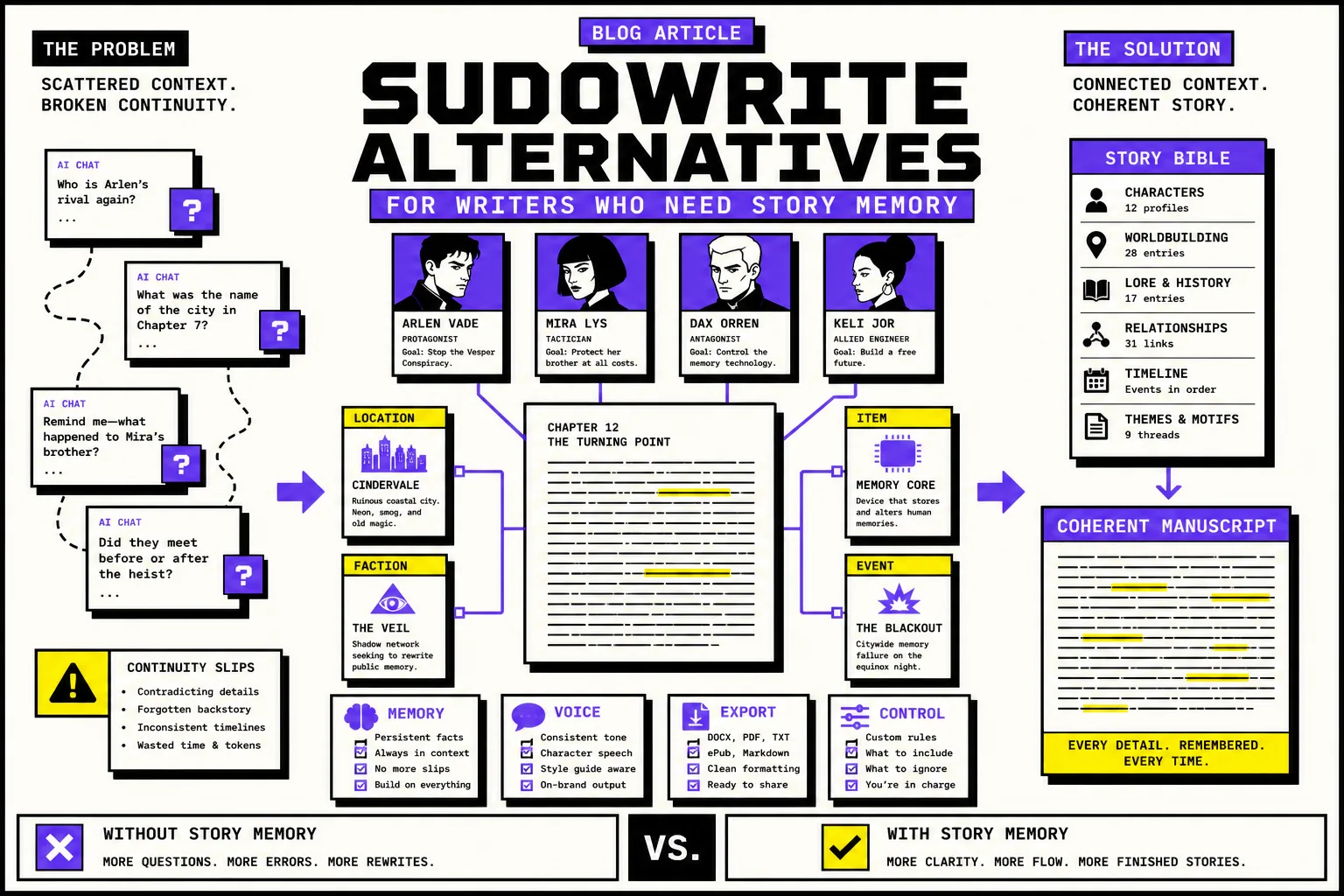
Sudowrite is easy to love on chapter one. The friction usually shows up later, when your outline has drifted, your side characters have changed, and you are spending credits reminding the AI what your own book is about.
If you are searching for sudowrite alternatives, that is probably the real problem you want solved. Not prettier prose. Real story memory. I checked official pricing and documentation for the tools below in June 2026, and I also read recent Reddit threads from working writers comparing Sudowrite, Novelcrafter, ChatGPT, and other setups. The same complaints came up again and again: credit anxiety, re-explaining context, and tools that know the outline better than the messy draft you are actually writing (thread one, thread two).
The honest answer is that Sudowrite is still good. It is just not the best fit for every novelist. If your priority is long-book continuity, voice control, and publishable exports, there are better fits.
The short version, if you are in a hurry:
- Best overall Sudowrite alternative for novelists: BookWitch, because the AI works from the current state of your manuscript instead of a stale outline.
- Best for power users who want to pick their own models: Novelcrafter.
- Best free Sudowrite alternative: a general chat model (Claude or ChatGPT on a free tier) for brainstorming and revision, or BookWitch's free uncensored AI chat if your fiction is dark or mature and mainstream assistants keep refusing it.
- Best if you write mature or explicit fiction: any tool built on an uncensored model. Sudowrite's own filters are looser than ChatGPT's, but they exist, and writers hit them.
The best Sudowrite alternatives at a glance
| Tool | Best for | Pricing model | Biggest trade-off |
|---|---|---|---|
| BookWitch | Novelists who need persistent story memory tied to the actual manuscript | Bundled plans, model access included on standard plans | Newer platform, less ideal for people who want to tinker with their own API stack |
| Novelcrafter | Power users who want deep planning, codex control, and BYOK flexibility | $4 to $20 per month for the app, plus your AI vendor costs | More setup, more manual process |
| NovelAI | Writers who want a lorebook-driven generation sandbox | $10 to $25 per month | Strong on generation, lighter as a full publishing workflow |
| Claude | Brainstorming, scene diagnosis, and revision help | $20 per month for Pro | Not a book-first workspace |
| ChatGPT | Flexible ideation, analysis, and fast drafting help | $20 per month for Plus | General-purpose chat, not long-form story infrastructure |
| Squibler | Writers who want aggressive full-book generation inside one app | Free tier, then $29.99 or $89.99 per month on monthly billing | More generation-first than craft-first |
What makes a good Sudowrite alternative for real story memory
If you publish to KDP or write multi-book fiction, here is the filter I would use.
- The AI should know the current state of the story, not just the original notes. A character who is single in chapter 3 and engaged in chapter 19 should not be frozen in the old version forever.
- You need control at the sentence level. The best setups let you accept, reject, or regenerate specific changes instead of dumping a blob of replacement prose into your draft.
- Your story bible should be connected, not ornamental. Linked character sheets, place notes, relationship history, and continuity checks matter more than a flashy "generate chapter" button.
- Export matters more than people admit. If your tool makes EPUB, DOCX, or PDF handoff painful, you will pay for that later when it is time to publish.
- Pricing has to fit the way novelists actually work. A binge-writing weekend and a slow revision month should not both feel financially punishing.
1. BookWitch, best overall if your dealbreaker is memory
BookWitch is the cleanest choice if the real reason you are leaving Sudowrite is story memory.
Its core difference is not that it can generate prose. Lots of tools can do that. The useful part is that the AI works with a persistent Story Bible, can track character, place, and relationship progression over time, and stays tied to the manuscript state at that point in the book. That means your heroine can have different emotional context in chapter 2 and chapter 22, and the tool does not have to pretend those are the same version of the character.
A few details matter in practice:
- character and world references are auto-linked, so you can jump from the draft into the relevant sheet
- continuity checks can catch classic long-book mistakes, like eye color changes or timeline slips
- voice matching lets you feed the system your prose, then generate closer to your style
- the Draft, then Polish workflow helps reduce the generic AI sheen that ruins a lot of fiction tools
- exports are built for authors, with clean EPUB, DOCX, and PDF output, which matters if you publish through KDP
- you stay in control of every generation, with accept, reject, and regenerate options instead of handing the whole scene to the machine
The fair caveat is that BookWitch is not the best choice for writers who enjoy building their own toolchain. If you love picking vendors, juggling API keys, and micro-optimizing model costs, Novelcrafter gives you more knobs. BookWitch is better if you want the long-form fiction workflow solved, not assembled.
2. Novelcrafter, best for power users who want control
If you want the strongest alternative to Sudowrite from a pure planning and system-design angle, start with Novelcrafter.
Its Codex acts like a story bible for characters, locations, objects, and other world details, and it can automatically detect entries by name and alias in your text. The app also supports scene-beat generation, series organization, and exports to DOCX or Markdown. As of June 2026, its pricing page lists monthly plans at $4, $8, $14, and $20, plus a 21-day free trial with no card required. The AI layer is BYOK, which means you pay Novelcrafter for the workspace and pay your model provider separately.
That BYOK model is either a strength or a headache.
It is a strength if you want to choose your own models, keep platform fees lower, or run local models. It is a headache if you want something that works out of the box. A lot of serious writers like the flexibility. A lot of newer writers bounce off the setup.
My honest take: Novelcrafter is excellent if you are organized, technical enough to manage AI vendors, and comfortable treating your process like a build. It is less ideal if you want the tool to understand the evolving draft with minimal maintenance. Even in recent Reddit discussions, the praise for Novelcrafter is often about structure and control, while the complaints are usually about extra manual work once the story starts drifting away from the original plan (example thread).
3. NovelAI, best for lorebook-heavy creative generation
NovelAI is still one of the most interesting Sudowrite alternatives if your brain works in lore, keys, and generation settings.
Its Lorebook lets you store characters, locations, factions, and other world data, then insert those entries into context when their activation keys appear. It also has a persistent Memory field that is always included in generation context. Pricing currently runs from $10 per month for Tablet to $25 per month for Opus, and the higher tiers increase context size, with Opus documented at up to 28,672 tokens of context. Paid plans also include unlimited text generation.
Where NovelAI wins is raw creative freedom. It is great for writers who like steering the model, tuning the feel, and living inside a lorebook-driven environment.
Where it loses for some novelists is workflow. NovelAI feels more like a creative generation studio than a manuscript-centered editor. If your real need is continuity checking, inline revision control, or clean production export for publishing, other tools are more directly built around that job.
4. Claude, best as a revision partner, not a full Sudowrite replacement
If you have ever used Sudowrite mostly for "fix this scene," "make this dialogue less stiff," or "what is the structural problem here," Claude Pro is worth a serious look at $20 per month.
Claude is excellent at:
- diagnosing why a scene feels flat
- offering multiple line-level rewrites with different tonal goals
- outlining sequels, subplots, or character arcs
- analyzing pacing and exposition problems in plain English
But Claude is not really a Sudowrite replacement by itself. It is a strong AI brain inside a chat interface, not a long-form fiction workspace with story infrastructure around it. You still need somewhere else to manage your draft, your canon, your exports, and your continuity system.
For a lot of pros, that is fine. They pair Claude with Scrivener, Word, or another writing app. For KDP authors who want everything in one place, it is usually not enough on its own.
5. ChatGPT, best generalist, weakest dedicated fiction workflow
ChatGPT Plus is $20 per month, which makes it a tempting Sudowrite alternative if you already use it for everything else.
And to be fair, ChatGPT is useful. It is fast, flexible, and good at brainstorming premises, generating scene options, pressure-testing outlines, analyzing reader objections, and helping you unstick a draft.
The issue is not capability. The issue is architecture.
ChatGPT is still a general-purpose assistant, not a novel-writing studio. When writers complain that they are tired of re-explaining their own book every new session, this is exactly the problem they mean (example thread). You can make it work with disciplined prompts and a separate story bible. You just have to do far more of the memory management yourself.
6. Squibler, best if you want aggressive book generation
Squibler deserves a mention because it is aimed much more directly at authors than Claude or ChatGPT are.
Its pricing page currently offers a free tier, a Plus plan at $29.99 per month on monthly billing, and a Pro plan at $89.99 per month. Squibler also leans hard into full-manuscript generation, claiming Plus can generate a full 200 to 300 page book and keep characters, plot, and structure consistent.
That makes it appealing if your main question is speed.
It also makes it a different kind of product from BookWitch or Novelcrafter. Squibler's pitch is much closer to "generate the book fast, then edit it" than "keep a complex long-form story coherent while I remain in tight control scene by scene." Some writers will love that. Serious novelists, especially series writers, should test it carefully before committing.
Is there a free Sudowrite alternative?
Sudowrite has a trial but no permanent free tier, and that is a common reason people go looking. Three honest free routes:
- A general chat model on its free plan. Claude and ChatGPT both let you brainstorm, diagnose scenes and rewrite passages for free, within daily limits. You manage the story memory yourself.
- BookWitch's free tools. The uncensored AI chat and the AI story generator work without an account for a first taste, then with a free account and a daily limit. They are scratchpads, not a manuscript workspace, but they will write the dark, romantic or explicit scene a mainstream assistant refuses.
- Local open-source models. Free and private, but you need a capable machine and a taste for setup, and small local models write noticeably worse than hosted ones.
None of these replaces a book-first workspace. They replace the part of Sudowrite people actually use for free: getting unstuck.
Sudowrite alternatives for mature and uncensored fiction
A quieter reason writers leave Sudowrite: filters. Sudowrite is more permissive than ChatGPT, but dark romance, erotica and graphic horror still trip refusals or softened prose from time to time, and every refusal costs credits.
If that is your genre, put the model's content policy at the top of your checklist, above features. Novelcrafter's BYOK setup lets you route to a permissive provider. BookWitch runs mature fiction through an uncensored model with one hard limit (nothing involving minors, nothing that causes real-world harm) and keeps the same story memory and export pipeline as everything else.
Is Sudowrite worth it, or should you switch?
Here is my short Sudowrite review: yes, Sudowrite is worth it for the right writer.
It still has one of the smoothest fiction-first onboarding experiences in the category. Its pricing page shows plans starting at $10 per month, and its core workflow is still strong for brainstorming, expansion, and getting unstuck. It also states that Sudowrite claims no rights over your work, does not use your writing to train Sudowrite or OpenAI's models, and lets you keep access to your projects after cancellation, even if paid AI features stop working.
Stay with Sudowrite if:
- you want the easiest creative writing AI to start using
- you mostly use AI for ideation, outlining, and scene expansion
- you like a prose-first workflow more than a systems-first workflow
- your books are shorter, simpler, or you do not mind actively managing context
Switch if:
- your real pain is continuity across a long novel or series
- you hate credit anxiety
- you want better accept, reject, and revision control
- you need cleaner KDP-ready export
- you want the AI to work from the current story state, not a stale snapshot
My honest recommendation for most serious novelists
If real story memory is your deciding factor, I would shortlist the options like this:
- Choose BookWitch if you want the best fit for long-form fiction, evolving story memory, voice matching, continuity checks, and clean author exports.
- Choose Novelcrafter if you want maximum control, BYOK flexibility, and do not mind building your own setup.
- Choose NovelAI if you want a lorebook-heavy sandbox and lots of raw generation.
- Choose Claude or ChatGPT if you mainly want an AI thinking partner and already have a writing home elsewhere.
- Choose Squibler if speed and full-book generation matter more to you than scene-by-scene control.
If you are a KDP self-publisher writing a series, my bias is simple: pick the tool that reduces continuity mistakes and cleanup work, not the tool that generates the flashiest paragraph on day one. That is what saves you time by book three.
If that sounds like your workflow, start with BookWitch first. If you are more technical and price-sensitive, test Novelcrafter next.
FAQ
What is the best Sudowrite alternative? For novelists whose pain is continuity across a long book, BookWitch. For writers who want to assemble their own toolchain and pick models, Novelcrafter. For pure generation freedom, NovelAI.
Is Sudowrite free? No. It offers a trial, then paid plans starting around $10 per month. The free routes are general chat models, local open-source models, or free tools like BookWitch's uncensored chat and story generator.
Sudowrite vs Novelcrafter: which is better? Sudowrite is easier to start with and more prose-first. Novelcrafter is more structured, cheaper for the app itself, and more work to run because you bring your own AI keys. Neither tracks the evolving state of the draft the way a manuscript-tied story bible does.
Which Sudowrite alternative is best for mature or NSFW fiction? One built on an uncensored model. BookWitch handles adult fiction with a single hard limit; Novelcrafter can, depending on the provider you plug in. Mainstream assistants are the weakest option here.
Can I export my book from these tools? BookWitch exports EPUB, DOCX and PDF. Novelcrafter exports DOCX and Markdown. NovelAI, Claude and ChatGPT expect you to copy your text into a proper manuscript tool for publishing.