7 Squibler Alternatives for Long-Form Fiction Writers
Looking for a Squibler alternative? Compare 7 tools for long-form fiction, story memory, continuity, and KDP-friendly export.
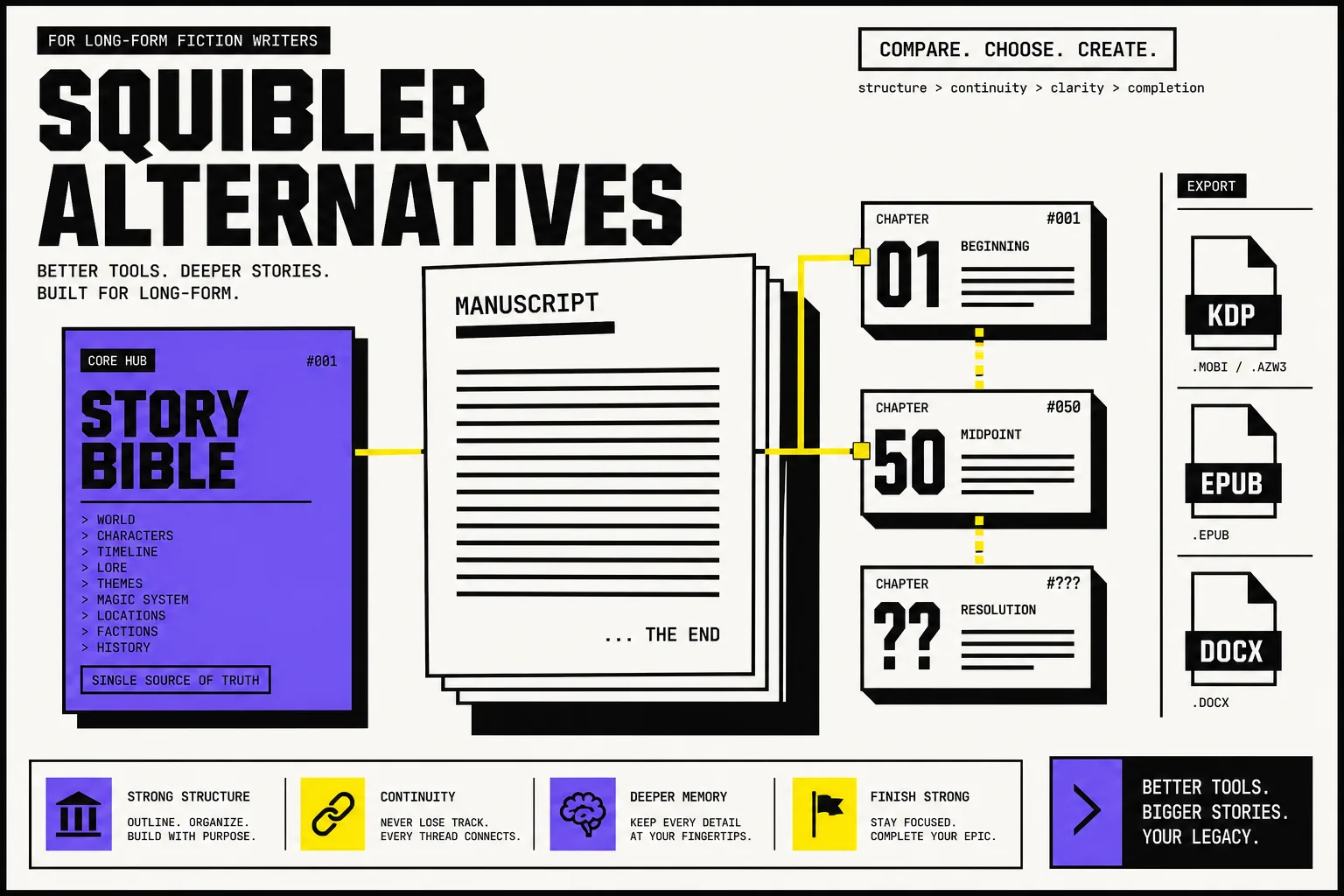
If Squibler got you from blank page to chapter three, but starts feeling thin by chapter twenty, you are asking the right question. Most KDP authors do not need more text generation. They need better memory, cleaner continuity, and exports that do not turn publishing week into cleanup week.
If you searched squibler, squibler io, the squibler app, or squibler writing software, this is the short list. I looked at what Squibler offers today, what Amazon KDP actually accepts for upload, and the pain points authors keep raising around long-form AI memory and chapter-to-chapter consistency in threads about long-form AI continuity and KDP-ready file formats.
Quick answer
For most fiction-first self-publishers, the best Squibler alternative depends on where your bottleneck actually is:
- BookWitch if your biggest problem is story-bible memory, character progression, and continuity across a full novel or series.
- Scrivener if you want maximum manual control and do not mind building your own system.
- Dabble if you want plotting and organization without Scrivener's heavier learning curve.
- Sudowrite if you want a stronger AI partner for ideation, drafting, and revision.
- LivingWriter if you want cloud-first organization with solid exports.
- Atticus if your draft is mostly done and formatting is the real job now.
- Reedsy Studio if you want a free finishing tool for EPUB and print PDF.
What Squibler does well, and where it starts to pinch
To be fair, Squibler is not a weak tool. Its current product includes a free tier, paid Plus and Pro plans, Elements that feed the AI context, exports to PDF, DOCX, and ePub, and recent additions like version control and shareable project links. Squibler also says you keep full ownership of your work. You can verify those on its pricing page, Elements guide, novel writing software page, release notes, and terms.
That is enough for a lot of writers.
Where some fiction authors outgrow it is not basic capability. It is depth of memory during a long project. Once you are juggling a cast, a timeline, a world bible, relationship drift, and fifty chapters of cause and effect, the question changes from "can this help me write" to "can this help me stay consistent without manual babysitting every session?"
That matters even more if you publish to KDP regularly. Amazon accepts common ebook inputs like DOCX, EPUB, and KPF, and for print you will often want a clean PDF workflow, so your writing tool has to get the manuscript out cleanly at the end, not just generate pages at the start. Amazon's own docs are worth bookmarking: the eBook manuscript formatting guide, supported Kindle content paths, and paperback and hardcover templates.
Which Squibler alternatives are best for long-form fiction writers?
Here is the honest list, ranked by how useful they are for novelists who care about finishing a coherent book, not just generating scenes.
| Tool | Best for | Why choose it over Squibler |
|---|---|---|
| BookWitch | Story memory and continuity | Persistent Story Bible, chapter-aware progression, continuity checks |
| Scrivener | Manual control | Best-in-class structure, research, corkboard, compile |
| Dabble | Plotting without clutter | Clean interface, plot grids, notes, export |
| Sudowrite | AI-heavy drafting and revision | Strong fiction AI tools, Story Bible, import, feedback |
| LivingWriter | Cloud organization | Boards, elements, collaboration, KDP-friendly export |
| Atticus | Final formatting | Fast path from draft to EPUB and print PDF |
| Reedsy Studio | Free finishing tool | Clean EPUB and print-ready PDF with professional typesetting |
1. BookWitch, best for authors who care about continuity
If your real frustration with Squibler is that long projects become fragile, BookWitch is the cleanest upgrade.
The core difference is not "more AI." It is better memory structure. BookWitch is built around a persistent Story Bible that stays with the manuscript, so characters, world details, and style stay coherent from chapter 1 to chapter 50. It also tracks progression, which matters more than most apps admit. A character in chapter 18 should not be treated like a frozen profile from chapter 2. Relationship states, world changes, and what each character knows can move with the story.
A few details matter a lot for self-publishers:
- Auto-linked Story Bible entries make it faster to check who a character is while drafting.
- Continuity checking helps catch mistakes like eye color changes, timeline slips, or relationship contradictions.
- Voice matching helps the AI suggest prose that sounds closer to you, not like generic platform copy.
- Draft to Polish workflow gives you a better shot at avoiding that slick, flattened AI tone.
- Exports are built for EPUB, DOCX, and PDF.
- Multilingual writing is there if you publish in more than one language.
If you write genre fiction, especially fantasy, romance, thriller, serialized fiction, or a connected series, this is the category advantage that matters most.
2. Scrivener, best for writers who want total control
Scrivener is still the reference point for long-form writing software because its structure is excellent. The Binder, Corkboard, Outliner, Research Library, Snapshots, and Compile system are built for large manuscripts, not blog posts pretending to be novels. Scrivener also exports to DOCX, ePub, Kindle, and PDF from one project, according to its features page.
Why writers switch from Squibler to Scrivener is simple: they want to own the architecture. You can break a manuscript into scenes, tag by POV or status, keep research inside the project, and move entire story sections around without a mess.
The tradeoff is equally simple. Scrivener gives you power, not hand-holding. If you want built-in AI memory or an app that actively helps maintain continuity, you will be creating that system yourself. Also, the learning curve is real. Even fans regularly talk about how much time it takes to learn Scrivener well, especially around compile and setup, as seen in threads like this Scrivener discussion and this compile help thread.
Best for: experienced self-publishers, heavy planners, writers who like systems.
3. Dabble, best for plotters who want less software overhead
Dabble sits in a useful middle ground. It is easier to get moving in than Scrivener, but still built for novels. Its official features include drag-and-drop story elements, plot grids, story notes, cloud sync, mobile support, and export of the manuscript, plot, and notes, according to Dabble's feature overview and help center.
That makes Dabble a strong Squibler alternative if your issue is not AI power, but narrative organization. It is especially good for writers who outline heavily, write in scenes, and want notes close to the draft.
Where it is less differentiated is the same place BookWitch pulls ahead: active long-form continuity intelligence. Dabble helps you organize the moving parts. It does not position itself as the tool that will deeply understand the state of your story at each chapter.
Best for: plot-driven novelists, writers who want structure without a steep setup cost.
4. Sudowrite, best for fiction writers who want a stronger AI co-writer
Sudowrite is the alternative I would look at if your favorite part of Squibler is the AI itself.
Its recent updates show a mature fiction workflow: a Story Bible, import reports when you bring in an existing manuscript, feedback tools that read the whole document with Story Bible context, and Story Bible-aware spelling and grammar. Sudowrite also uses a credit-based pricing model across plans, documented in its plan docs and changelog.
That makes it appealing if you want help with:
- brainstorming
- scene expansion
- rewrites
- editorial feedback
- faster iteration inside one fiction-focused AI environment
The caution is practical. If you dislike credit systems, or if your main pain is chapter-to-chapter continuity in a long series, Sudowrite may not be the final answer on its own. It is very good at being an AI writing partner. Some authors still want a tighter continuity scaffold around that partner.
If Sudowrite is also on your shortlist, read our deeper breakdown at /blog/sudowrite-alternatives.
Best for: authors who want powerful AI drafting and revision, not just organization.
5. LivingWriter, best for cloud-first drafting with built-in structure
LivingWriter has become a serious option for writers who want one browser-based workspace for planning, drafting, and exporting. Its current site highlights boards, elements, AI chat, AI analysis, version history, auto-save, and exports to DOCX, PDF, EPUB, and Amazon KDP. The current pricing page also positions a free plan for one manuscript, a Pro tier, and a Pro + AI tier. You can confirm the feature set on the main LivingWriter site and the current pricing page.
I think LivingWriter is strongest for authors who want structure without going full Scrivener. Its Appears In and element-linking features are useful for keeping track of where characters, settings, and objects show up.
It is a fair Squibler alternative if your wish list is:
- cloud-based drafting
- solid manuscript organization
- collaboration and sharing
- KDP-friendly export options
- lighter AI support beside the draft
What it is not, at least from its positioning, is a continuity-first system built around deep story-state tracking across a long series.
Best for: writers who want an all-in-one web app with good organization and export.
6. Atticus, best for finishing and formatting a book for sale
A lot of authors think they need a new drafting tool when what they really need is a better last-mile publishing tool.
That is Atticus.
Atticus lets you import an existing manuscript, choose from formatting themes, preview the book on multiple device types, and export to ePub, PDF, and DOCX. Its site also stresses that you can use the same project for both digital and print outputs. See the official Atticus homepage, quick start guide, and formatting help article.
So if your pain with Squibler is actually this:
I can get words on the page, but my EPUB, print PDF, and final interior still eat a weekend.
then Atticus may be the more profitable move.
It is not the best answer for long-form AI memory. It is one of the best answers for turning a completed manuscript into publishable files.
If you are close to release, pair this with our /blog/kdp-publishing-checklist.
Best for: KDP authors who already have a draft and need professional packaging.
7. Reedsy Studio, best free option for clean export
Reedsy Studio earns a spot here because many self-publishers do not need another drafting environment. They need a free, reliable formatter.
Reedsy Studio exports EPUB 3 and print-ready PDF, supports several trim sizes, and positions itself as a professional typesetting tool for authors. Its own page is clear that the core writing and formatting functions are free, with optional premium plans layered on top. See the Reedsy Studio page.
This makes Reedsy a smart Squibler alternative when:
- your manuscript is already stable
- you want a cleaner handoff to ebook and print
- budget matters
- you care more about presentation than in-editor AI
I would not pick Reedsy as my continuity engine for a fantasy saga. I would absolutely use it if I needed a fast, clean way to produce a professional-looking file.
Best for: budget-conscious self-publishers and final formatting.
Who should stay with Squibler?
Not everyone should switch.
You may be better off staying with Squibler if:
- you mainly want AI help generating or extending scenes
- your projects are shorter or simpler
- Squibler's Elements are enough to keep your story straight
- you like its newer features such as version control and share links
- exporting to PDF, DOCX, or ePub covers your workflow already
If that sounds like you, the cost of moving may be higher than the benefit.
My honest recommendation for KDP self-publishers
If you publish commercial fiction on Amazon, I would make the decision like this:
Choose BookWitch if...
You write long-form fiction where continuity errors cost real revision time. That is especially true for fantasy, romance series, mystery, fanfiction, and any project with a large cast or evolving world state.
Choose Scrivener or Dabble if...
You are more interested in structure and control than AI help. Scrivener is deeper. Dabble is easier.
Choose Sudowrite if...
You want a more capable fiction AI partner for brainstorming, drafting, and feedback, and you are comfortable with credits.
Choose Atticus or Reedsy if...
Your draft is basically done and the real bottleneck is shipping clean files to KDP.
That last point matters more than people think. The wrong software choice is often not a bad writing app. It is a good writing app used for the wrong stage of the publishing process.
Final take
The best Squibler alternative for most long-form fiction writers is not the app with the most features. It is the one that removes your current bottleneck.
If your bottleneck is memory and continuity, BookWitch is the strongest fit.
If your bottleneck is manual structure, pick Scrivener or Dabble.
If your bottleneck is AI drafting power, look hard at Sudowrite.
If your bottleneck is formatting for sale, go Atticus or Reedsy.
That is the simplest way to avoid buying the wrong tool twice.