Squibler AI vs BookWitch: Which Helps You Finish a Book?
Comparing Squibler AI vs BookWitch for beginners: setup, drafting help, export, and which tool better keeps your story coherent.
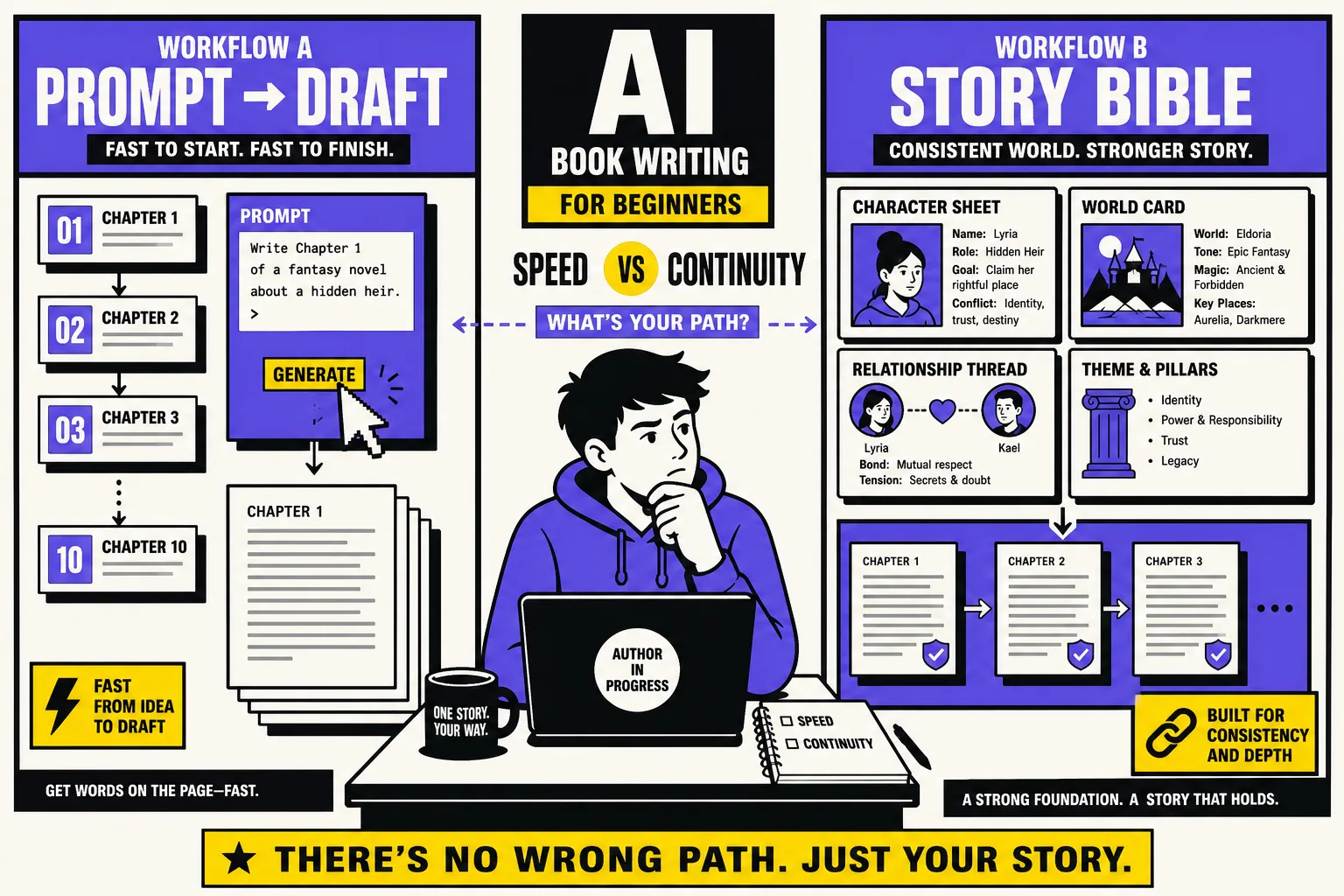
If you're searching for squibler ai, you probably are not looking for a philosophical debate about AI and art. You want to know something practical: which tool will actually help you finish your first book.
That is the real beginner problem. Not idea generation. Not fancy prompts. Finishing.
Recent Reddit threads from would-be authors keep circling the same fears: paying for months, getting words on the page but not a coherent manuscript, and discovering too late that the tool helped them start but not finish (example 1, example 2). That is why this comparison matters.
Based on the current public product pages and help docs for both tools in June 2026, here is the short version: Squibler is stronger if you want a fast prompt-to-draft jump start. BookWitch is stronger if you want the AI to stay grounded in your characters, world, and voice as the book changes. For a beginner writing fiction, the second problem usually matters more by chapter 10 than the first problem did on day 1.
If you want the bigger category view first, read our guide to what an AI book writer should actually do for authors.
Squibler AI vs BookWitch at a glance
| Category | Squibler AI | BookWitch |
|---|---|---|
| Best for | Beginners who want a fast jump from idea to draft | Beginners writing fiction who care about continuity across a full book |
| Setup | Start from a blank draft or generate a structured draft and full-length book, with chapters, scenes, and Elements (blank draft, generate book, features) | Start with genre, language, a short pitch, then build a Story Bible the AI can read across the manuscript (BookWitch) |
| Drafting help | Full-length book generation, Smart Writer revisions, scene continuation, templates, and goal tracking (homepage, features) | Scene drafting, rewriting, continuation, and revision suggestions shown as a diff you accept or reject (BookWitch) |
| Character and world memory | Uses Elements for characters, settings, objects, and plot details that the AI references while writing (Elements guide, features) | Uses a persistent Story Bible the AI reads while drafting, with linked entities and memory across the book (BookWitch) |
| Export | PDF, Word, and ePub export (Squibler export formats) | Kindle EPUB, print-ready PDF for KDP, plus document export and KDP-focused publishing help (BookWitch) |
| Languages | Optimized for full-length manuscript generation in English, with translation help in chat for other languages (language tutorial) | Handles several languages and answers in your project's language (BookWitch FAQ) |
The simple answer is this:
- Pick Squibler if your biggest obstacle is getting a draft started.
- Pick BookWitch if your biggest obstacle is keeping the draft coherent enough to finish.
Setup: which one gets you writing faster?
If the blank page is what stops you, Squibler has the friendlier first hour.
Its public workflow is very direct. You can open a blank draft, or you can describe your idea and let the software generate a structured draft with chapter outlines, scene beats, and opening prose. It also offers a "Generate Full-Length Book" flow, plus templates, chapter organization, and goal tracking (Squibler getting started, Squibler features).
For a beginner, that matters. A tool that gets you from "I have an idea" to "I have pages" in minutes can feel like magic. And sometimes that is exactly what you need.
But there is a trade-off. When a tool starts by generating a lot for you, it can also generate a lot about your book before you have made the hard creative decisions yourself. The first session feels fast. The cleanup often arrives later.
BookWitch is a little more deliberate upfront. Its public flow is: create a project, choose the genre and language, add a short pitch, then feed the Story Bible with the characters, locations, factions, and other story elements the AI should actually use (BookWitch homepage).
That is slightly slower on minute 1. It is often faster on chapter 12.
So if your question is purely setup friction, Squibler wins. If your question is how often will I need to re-explain my own book, BookWitch has the sharper answer.
Drafting help: what does each tool do when you get stuck?
This is where squibler writing and BookWitch start to reveal their personalities.
Squibler is built to help you produce a lot quickly. Its product pages emphasize full-draft generation, scene continuation, AI Smart Writer revisions, story outlines, templates, and project management (Squibler homepage, book writing software page). If you want the software to give you momentum, it clearly leans into that.
That makes Squibler attractive for beginners who freeze at the sentence level. If you often think, "I know the story, I just need something to react to," Squibler's approach makes sense.
BookWitch feels more like a co-writer in the manuscript than a generator above it. Publicly, its core pitch is not "watch me write a whole book for you." It is "the AI knows your story, stays in flow, and shows its changes as a diff so you can accept, edit, or reject them" (BookWitch homepage).
That control matters more than beginners usually expect. The fastest way to lose confidence in an AI tool is to feel like it keeps rewriting your book into somebody else's voice. BookWitch leans hard in the other direction: suggestion, not replacement.
This is also where voice matching matters. BookWitch has a public style matching tool built around feeding the AI a writing sample so it can adapt tone, rhythm, and structure more closely to that source (BookWitch style matching). For a first-time author, that becomes much more valuable after the novelty of generation wears off and you start caring whether chapter 14 still sounds like chapter 2.
My take for beginners is simple:
- If being stuck at zero words is your core problem, Squibler may feel more immediately useful.
- If being stuck rewriting bad or off-voice AI output is your core problem, BookWitch is the better fit.
Character and world state: this is where the comparison gets serious
Most comparison posts stop at "both have AI". That misses the whole point.
The hard part of a novel is not producing text. The hard part is producing text that still makes sense later.
Squibler does have more structure than a generic chatbot. Its documentation says you can create Elements for important characters, settings, objects, and ideas, and that the AI pulls from those descriptions while generating text, images, and dialogue (Elements guide). Its book-writing page also says Elements help characters stay consistent and contradictions get caught early (Squibler features).
That is real value. For a beginner, Elements are much better than pasting the same character sheet into a chat window over and over.
But based on Squibler's public docs, its memory model is still best understood as reference-card memory. You define characters, settings, and plot details, and the AI refers back to them. That is useful. It is not quite the same thing as an evolving, point-in-story memory system where the tool understands that a relationship changed in chapter 9, a lie was exposed in chapter 14, and a character's emotional state should now be different.
That is where BookWitch's approach is stronger for fiction. Its core product pitch is a Story Bible the AI actually reads, with characters, places, factions, and objects linked into the writing workflow, plus manuscript-aware assistance across the book (BookWitch homepage). In practice, BookWitch is built around the idea that your story state changes over time, and the AI should draft from that evolving state instead of a frozen card file.
Why does that matter so much for beginners?
Because the middle of the book is where enthusiasm dies. The world gets bigger. The cast spreads out. Motivations shift. Secrets get revealed. Recent discussions from writers building elaborate worlds often hit the same wall: they have plenty of setting, but turning that into a finished story is harder than expected (example discussion).
If you are writing:
- fantasy
- romance with recurring side characters
- mystery
- sci-fi with factions or lore
- anything planned as a series
then continuity is not a bonus feature. It is the thing that decides whether the draft remains usable.
For this category, BookWitch has the clearer edge.
Export and publishing: can you leave with a usable file?
This part gets ignored until it hurts.
Squibler says it exports completed books as PDF, Word, or ePub, and positions those files as ready for self-publishing platforms or publisher submission (Squibler export formats). That is a strong, flexible export set, especially if you want to hand the manuscript to an editor in Word.
BookWitch is more opinionated, and that is good if Amazon KDP is your likely destination. Its public site emphasizes one-click Kindle EPUB, print-ready paperback PDF, KDP metadata help, and a pre-flight check against Amazon's publishing rules (BookWitch KDP workflow).
So the export difference is not really about which tool has an export button. Both do.
It is about what the export is trying to help you do.
- Squibler gives you flexible book-file output.
- BookWitch is more tightly aimed at getting a novelist to a KDP-ready package with less extra tooling.
If self-publishing on Amazon is your plan, that focus matters. We covered the formatting side of that in more depth in our Kindle formatting guide.
What about multilingual writing?
This is a quiet but important difference.
Squibler's own tutorial says that, as of June 2026, it is optimized to generate full-length manuscripts in English, though you can translate content into other languages through the editor chat afterward (Squibler language tutorial).
BookWitch, by contrast, says the interface and writing workflow handle several languages, and that the AI answers in the project's language (BookWitch FAQ).
If you are a beginner writing in English only, this may not matter. If you are bilingual, drafting in French, or planning multiple editions, it matters a lot.
Who should choose Squibler AI?
Choose Squibler AI if most of these sound like you:
- You want the quickest path from idea to draft.
- You like templates, goal tracking, and a more guided prompt-to-book workflow.
- You are writing in English.
- You do not mind doing more continuity checking and cleanup as the draft grows.
- You want Word export in the normal workflow.
For the right beginner, that is a perfectly reasonable choice. Some writers need acceleration more than they need deep continuity support on day 1.
Who should choose BookWitch?
Choose BookWitch if most of these sound like you:
- You are writing fiction, not just testing prompts.
- You care about character consistency, world state, and relationship changes across many chapters.
- You want the AI to suggest, not take over.
- You want revisions shown as diffs so you can stay in control.
- You care about matching your own prose more closely over time.
- You want KDP-friendly export, multilingual support, and a cleaner bridge from draft to publish.
For beginners, that combination is unusually practical. It solves the exact moment where many first books collapse: not the start, but the long middle.
Final verdict: which one helps you finish a book?
Here is my honest answer.
Squibler is easier to get excited about in the first hour. BookWitch is easier to live with in the middle and end of a book. And for most beginners, the middle and end are where the real battle happens.
So if your question is, "Which tool helps me start?", Squibler has a strong case.
If your question is, "Which tool helps me finish a coherent novel without constantly repairing memory, tone, and continuity?", I would pick BookWitch.
That does not make Squibler bad. It just means the two tools are optimized for different failure points. Squibler is a better spark. BookWitch is a better long-form companion.
And if you are still shopping around, our roundup of Squibler alternatives is a good next step.