The Hero's Journey (Monomyth): All 12 Stages Explained for Writers
The hero's journey, or monomyth, explained for writers: all 12 stages of Joseph Campbell's structure, the 3 acts, a worked example, and when to break the formula.
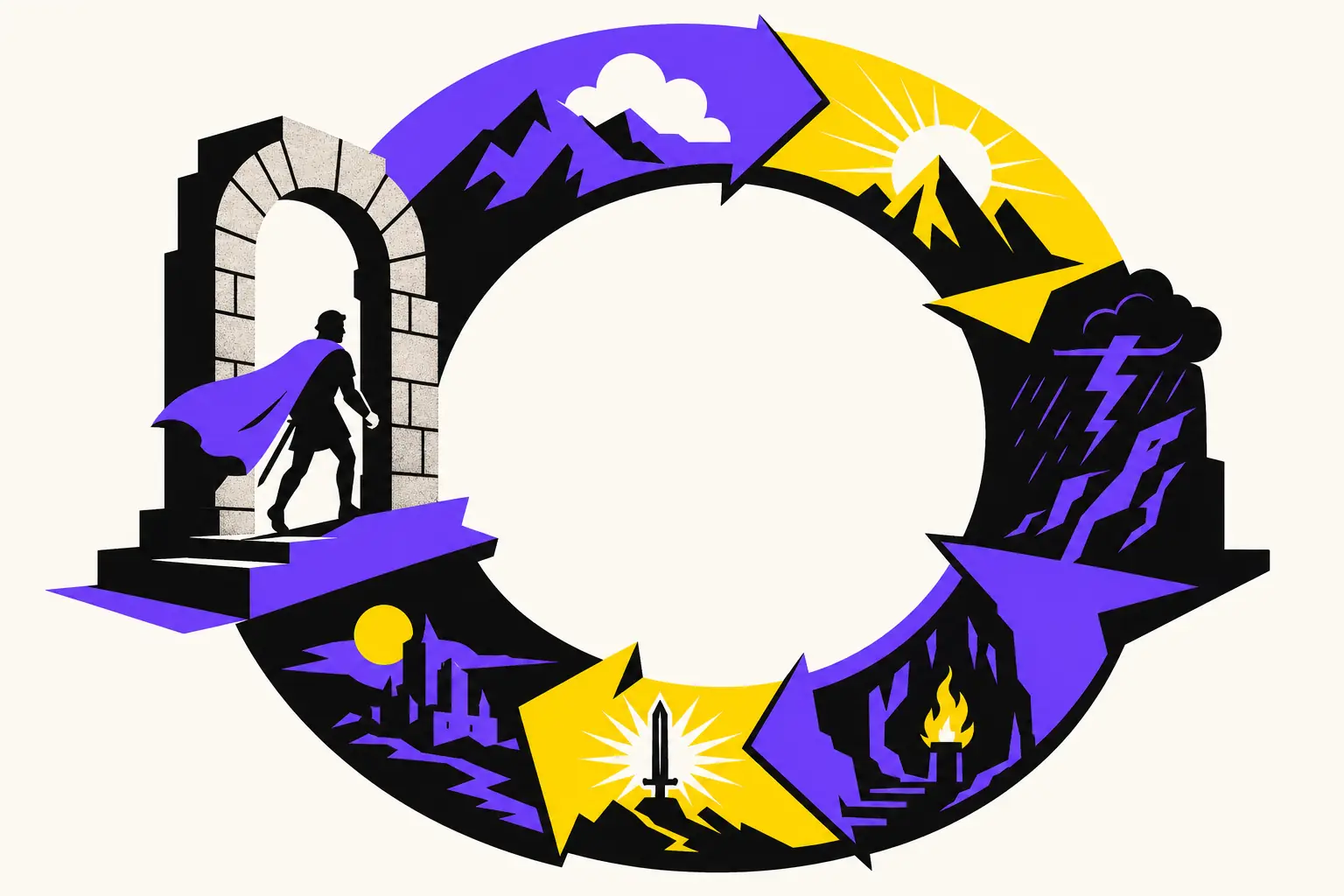
The hero's journey — also called the monomyth — is the most influential story structure in the world, and also the most misunderstood. Used well, it's a map for the deep emotional logic of transformation. Used badly, it's a paint-by-numbers template that makes every story feel the same.
This guide explains all 12 stages clearly, shows you a worked example, and — just as important — tells you when to ignore it.
Where the monomyth comes from
The term monomyth comes from mythologist Joseph Campbell, whose 1949 book The Hero with a Thousand Faces argued that myths across cultures share one underlying template: a hero leaves the ordinary world, faces an ordeal in a strange one, and returns transformed.
Campbell originally outlined 17 stages. The version writers actually use is the 12-stage model that screenwriter Christopher Vogler distilled in his memo-turned-book The Writer's Journey, written for Hollywood. Vogler's 12 stages are what became gospel in screenwriting rooms — so that's the version we'll use here.
It breaks into three acts: the Departure, the Initiation, and the Return.
The 12 stages of the hero's journey
Act I — The Departure
1. The Ordinary World. We meet the hero in their normal life, before the adventure. This is where you establish who they are and — crucially — what's missing or unbalanced. Luke on the farm; Katniss in District 12.
2. The Call to Adventure. Something disrupts the ordinary world and presents a challenge. The story's central problem arrives.
3. Refusal of the Call. The hero hesitates. Fear, duty, or doubt makes them want to stay home. This reluctance makes them human and raises the stakes.
4. Meeting the Mentor. A guide gives the hero wisdom, training, or a tool they'll need. Gandalf, Haymitch, Obi-Wan. The mentor lowers the hero's resistance and ours.
5. Crossing the Threshold. The hero commits and leaves the ordinary world for the special world. Act I ends; there's no going back.
Act II — The Initiation
6. Tests, Allies, and Enemies. In the special world, the hero learns its rules, makes friends, and meets opponents. This is where most of your middle lives.
7. Approach to the Inmost Cave. The hero prepares for the major challenge. Tension builds; plans are made; doubts resurface.
8. The Ordeal. The central crisis. The hero faces their greatest fear or a life-or-death moment, and something in them dies — often the old self. This is the emotional low point and the structural heart of the story.
9. The Reward (Seizing the Sword). Having survived, the hero claims something: a prize, knowledge, reconciliation, or power. But the journey isn't over.
Act III — The Return
10. The Road Back. The hero commits to returning to the ordinary world. Often the consequences of the ordeal chase them — a final complication raises the stakes again.
11. The Resurrection. The climax. The hero faces a final, often deadlier test, and must use everything they've learned. They're purified and transformed — proving the change is real.
12. Return with the Elixir. The hero comes home, changed, carrying something that benefits the ordinary world — wisdom, healing, freedom. The world they left is now rebalanced.
A worked example in one sentence per stage
The Lord of the Rings (Frodo): Hobbit in the Shire (1) → inherits the Ring (2) → "I can't take it" (3) → Gandalf guides him (4) → leaves the Shire (5) → fellowship, allies, Nazgûl (6) → approaches Mordor (7) → Shelob / Mount Doom (8) → the Ring is destroyed (9) → escape the erupting mountain (10) → survives, transformed (11) → returns to a Shire he can never fully belong to again (12).
Notice that last beat: the elixir isn't always triumphant. Frodo saves the world but can't live in it. That's the monomyth doing something deep, not formulaic.
When NOT to use the hero's journey
Here's what most guides won't tell you. The monomyth is a description of a certain kind of story, not a prescription for all of them.
- It's hero-centric and individualist. Ensemble stories, community stories, and many literary novels don't fit, and forcing them flattens what makes them good.
- It can feel mechanical. If readers can feel the template, you've used it as a cage instead of a skeleton.
- It's not the only structure. Save the Cat, the Seven-Point Structure, Kishōtenketsu (which has no central conflict at all), and the simple three-act all do different jobs.
Use the hero's journey as a diagnostic, not a recipe. When a draft feels flat, ask: is my hero actually transformed? Is there a real ordeal where the old self dies? Does the ending rebalance what was broken at the start? Those questions are the useful part. The stage list is just scaffolding.
Turning structure into an actual draft
Knowing the 12 stages is the easy part. The hard part is holding the whole arc in your head while you write 90,000 words — making sure the ordeal in chapter 24 pays off the wound you established in chapter 2.
That's exactly the kind of continuity a writing studio should carry for you. BookWitch lets you outline your structure, keep a Story Bible of characters and their arcs, and write with an AI that remembers the whole story — so when your hero is supposed to be transformed by the Resurrection, the tool actually knows who they were in the Ordinary World. Structure is a promise to the reader; we help you keep it.
Need to name the hero before you send them on the journey? Try our free fantasy name generator.