What Are Mannerisms? 100+ Examples to Make Characters Unforgettable
What are mannerisms, and how do you use them in fiction? A writer's guide with 100+ mannerism examples — verbal, physical, nervous and habitual — to bring characters to life.
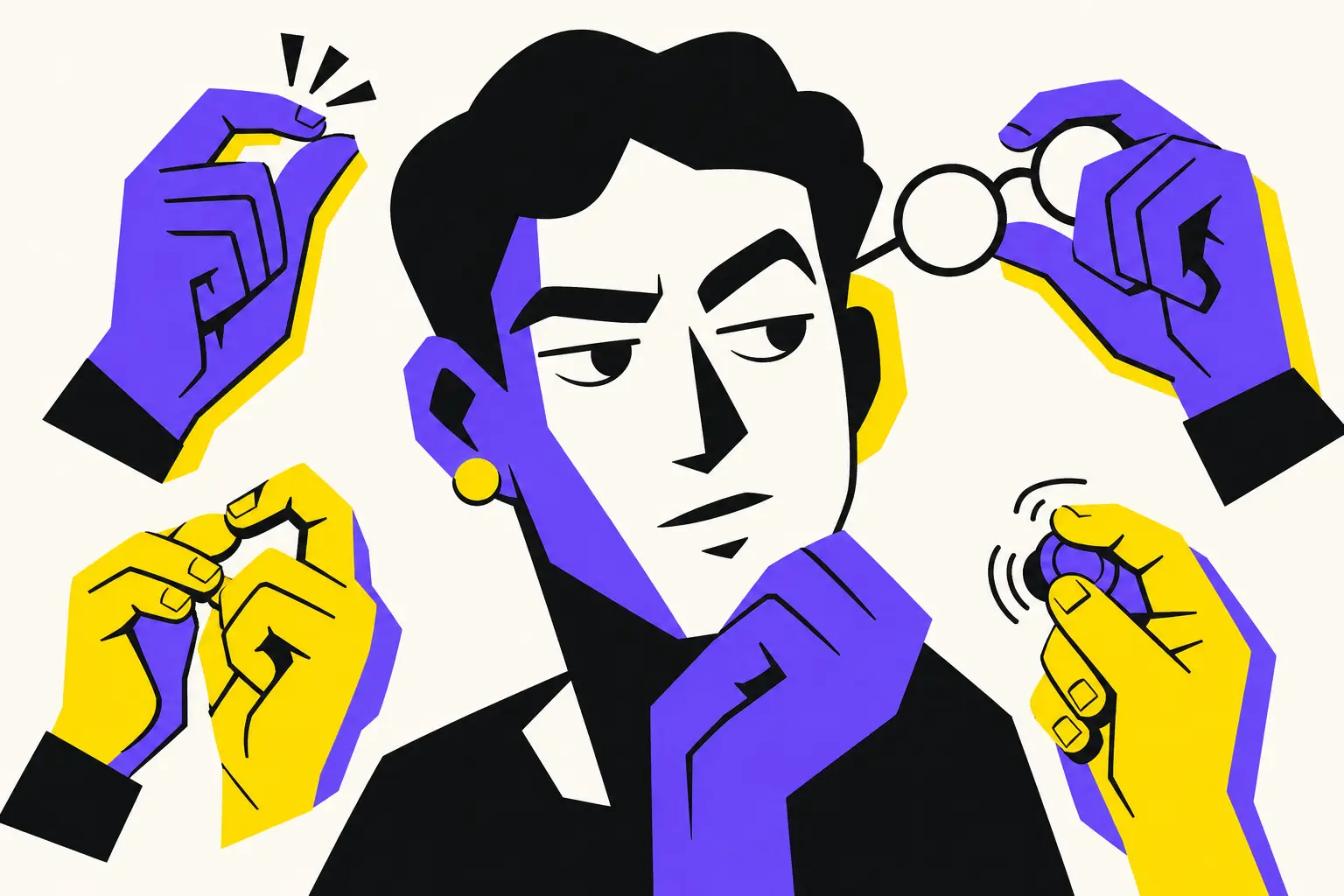
Readers don't remember your characters because of their backstories. They remember them because of the small, specific things they do — the way one taps a ring against a glass when she's lying, the way another never finishes his sentences. Those are mannerisms, and they're one of the cheapest, most powerful tools in fiction.
Here's what they are, why they work, and 100+ examples you can steal.
What are mannerisms?
A mannerism is a habitual, often unconscious gesture, speech pattern, or behavior that's characteristic of a particular person. In fiction, mannerisms are the repeated physical and verbal tics that make a character feel like an individual rather than a description.
They're different from a one-off action. A mannerism recurs — and because it recurs, it becomes shorthand. Once your reader learns that a character cracks his knuckles before he lies, you can show tension without explaining a thing.
Why mannerisms matter
- They show, they don't tell. "She was anxious" is a label. "She kept turning her wedding ring with her thumb" is a scene.
- They individualize. In a dialogue between three people, distinct mannerisms let the reader track who's who without dialogue tags.
- They reveal interiority. What a character does with their hands when they're uncomfortable tells us more than what they say.
- They create payoff. A mannerism established early can land hard later — when it changes, disappears, or betrays a character at the worst moment.
100+ mannerism examples by type
Use these as seeds, not a checklist. The goal is to pick one or two signature mannerisms per major character — not to pile on twitches.
Verbal mannerisms (how they speak)
- Says "right?" at the end of every statement
- Never uses contractions, ever
- Trails off and lets others finish their sentences
- Over-explains, then apologizes for over-explaining
- Calls everyone by a nickname they invented
- Quotes movies in casual conversation
- Answers questions with questions
- Drops into a second language when emotional
- Uses someone's full name when annoyed
- Starts hard truths with "Look…"
- Speaks in lists ("First, second, third…")
- Repeats the last word you said as a question
- Mutters numbers while thinking
- Says "anyway" to escape any uncomfortable topic
- Compulsively corrects other people's grammar
- Whispers when telling the most ordinary secrets
- Laughs at the end of every sentence, nervous or not
- Uses outdated slang with total confidence
Physical / body-language mannerisms
- Taps a ring or pen against the table when impatient
- Cracks knuckles before saying something difficult
- Tucks hair behind one ear repeatedly
- Stands with arms crossed even when relaxed
- Bounces one leg constantly while seated
- Touches their own throat when nervous
- Steeples their fingers before delivering bad news
- Rubs the back of their neck when caught out
- Chews the inside of their cheek
- Pushes glasses up the nose even when they haven't slipped
- Drums fingers in a fixed rhythm
- Picks at the label on a bottle
- Stands too close in conversation
- Smooths nonexistent wrinkles from their clothes
- Clenches and unclenches a fist under the table
- Always sits where they can see the door
- Pockets and unpockets their hands, unsure what to do with them
- Looks up and to the left when inventing a lie
Nervous / stress mannerisms
- Bites a thumbnail to the quick
- Twists a strand of hair around one finger
- Jingles keys or coins in a pocket
- Clicks a pen open and shut, open and shut
- Picks at a hangnail until it bleeds
- Wipes already-dry palms on their jeans
- Counts something — ceiling tiles, breaths, steps
- Bounces the heel of one foot
- Adjusts and readjusts a watch
- Holds their breath without realizing
- Touches a necklace or pendant like a talisman
- Paces in a tight, repeated pattern
Habitual / routine mannerisms
- Always takes the same seat in any room
- Lines up objects so the edges are parallel
- Smells food suspiciously before every bite
- Reads the last page of a book first
- Refuses to step on cracks, decades into adulthood
- Drinks coffee that's gone stone cold without noticing
- Checks the locked door twice, then a third time
- Eats foods one type at a time, never mixed
- Hums the same tune when concentrating
- Carries a lucky object and panics without it
- Folds receipts into tiny squares
- Narrates their own actions under their breath
Facial / expressive mannerisms
- Raises one eyebrow instead of asking
- Smiles only with the mouth, never the eyes
- Bites the lower lip when thinking
- Has a laugh that's mostly silent
- Squints when skeptical, regardless of the light
- Flares the nostrils a half-second before losing their temper
- Looks down and smiles when complimented
- Clenches the jaw so you can see the muscle move
- Widens the eyes theatrically to mean the opposite
How to use mannerisms without overdoing it
The most common beginner mistake is giving every character a fistful of tics until the page reads like a nervous-habits convention. Instead:
- Pick one or two signature mannerisms per important character and use them consistently.
- Tie the mannerism to character. The control freak lines up his cutlery; the liar can't hold eye contact. Make it mean something.
- Use change as a tool. When a character's signature mannerism vanishes — the fidgeter goes perfectly still — the reader feels the shift before you explain it.
- Don't narrate the meaning. Show the gesture and trust the reader. "He cracked his knuckles" beats "He cracked his knuckles, a sign he was nervous."
Keeping mannerisms consistent across a whole novel
The catch with mannerisms is consistency. If your detective taps his ring in chapter 2, he should still do it in chapter 30 — and the reader will notice if his eye color changes or his nervous tic quietly disappears.
This is exactly the kind of detail a writing studio should track for you. BookWitch keeps a Story Bible for every character — including the small, signature traits like mannerisms — and writes with an AI that remembers them across the whole manuscript, so your characters stay themselves from the first page to the last. Continuity is what turns a memorable gesture into a memorable character.
Still building that character from scratch? Spin up a name first with our free character & fantasy name generators.